
The national energy plan earmarks €4bn for electric buses and trucks by 2030. Greece registered 85 electric trucks last year, and seven in the first half of this one.
230,000 electric heavy freight trucks sold worldwide in 2025, up from about 84,000 (IEA, 2026)
4.8% EU electrically chargeable truck share of new registrations, H1 2026 (ACEA, July 2026)
7 electric trucks registered in Greece in H1 2026, out of 351, after 85 in full-year 2025 (ACEA, 2026)
2–3x purchase price of an electric truck relative to a diesel equivalent (IEA, 2026)
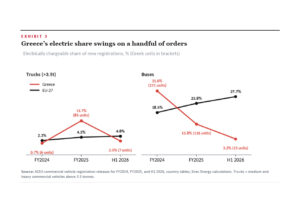
Greece’s revised National Energy and Climate Plan (NECP) sets aside about €4bn for electric buses and heavy-duty trucks between 2025 and 2030.3 In the first six months of 2026 the country registered seven electric trucks out of 351 sold, a 2.0 per cent share, after 85 across the whole of 2025. Electric buses took 15 of 468 new registrations, or 3.2 per cent, down from 19.3 per cent a year earlier.2
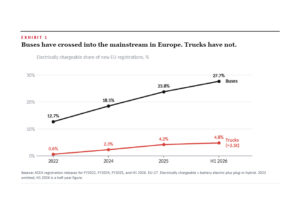
The shortfall does not reflect immature technology. Global electric truck sales passed 400,000 units in 2025, twice the previous year’s level, and sales of electric heavy freight trucks almost tripled, from about 84,000 to 230,000.1 Across the EU, electrically chargeable trucks took 4.8 per cent of new registrations in the first half of 2026, up from 3.6 per cent a year earlier. Electric buses took 27.7 per cent.2
A Chinese market with a European regulatory tail
The global figures need a caveat. China accounted for more than 90 per cent of electric truck sales in 2025, supported by a scrappage scheme worth up to about $20,000 per vehicle and by tighter fuel-consumption standards.1 Europe sold close to 17,000. Commercial forecasts built on that base assume the Chinese cost curve travels west: Fortune Business Insights expects the heavy-duty electric truck market to grow from $12.3bn in 2025 to $101bn by 2034, a compound annual rate of 27.1 per cent.4 Some of that curve will travel. Asia-Pacific already holds roughly 69 per cent of the market.4

Europe’s adoption runs on regulation rather than price. EU CO2 standards for heavy-duty vehicles, in force since 2025, require a 15 per cent emissions cut against 2019 levels, and battery-electric trucks and buses benefit from road-toll exemptions.1 Germany, the Netherlands, and France accounted for 74 per cent of the EU’s electrically chargeable truck registrations in the first half of 2026.2 Greece does not register on that list.
A market that moves one order at a time
Greece’s electric share does not trend; it lurches. Electric trucks rose from six units in 2024 to 85 in 2025, a 13.7 per cent share that put Greece well above the EU average of 4.2 per cent, then fell back to seven in the first half of 2026.2 Buses show the same pattern in reverse: a 31 per cent electric share in 2024, 11.8 per cent in 2025, 3.2 per cent in the first half of 2026. The swings track public procurement, not operator demand. Athens and Thessaloniki are absorbing Yutong electric buses in tranches funded by the Recovery and Resilience Facility, including 125 twelve-metre buses for Athens and 50 articulated buses for Thessaloniki contracted for 2026 delivery.9 The second half of 2026 will look very different from the first. None of it describes a market in which fleet operators buy electric vehicles on commercial grounds.
The replacement need is not in doubt. Greece runs the oldest truck fleet in the EU, averaging 22.9 years against 14.0, and 95 per cent of its 195,728 trucks are more than a decade old. Its buses average 17.2 years against 12.2.8
The binding constraint is capital. An electric truck still costs two to three times as much as its diesel equivalent.1 The vehicle is only the first line of the bill: depot chargers, grid connections, energy contracts, and fleet software follow. For municipal operators and mid-sized logistics fleets, that is an upfront capital requirement they cannot carry, however favourable the running costs.
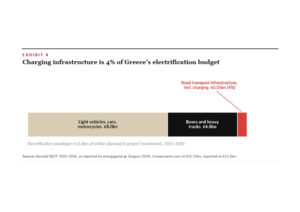
The NECP’s own arithmetic widens the gap. Of €44bn in planned transport investment, €12.6bn goes to electrification: €8bn for light vehicles, cars, and motorcycles, €4bn for buses and heavy trucks, and €549m for road-transport infrastructure, charging included.3 Infrastructure is 4 per cent of the envelope. The headline charging estimate of 40,000 to 100,000 public points by 2030, against 4,014 installed in September 2023, is built around passenger cars.5 Heavy fleets do not charge at the kerbside. They charge overnight at depots, where the grid connection rather than the charger typically sets both the cost and the timeline. The plan also hedges its bets, naming LNG and bio-LNG as transition fuels for heavy road transport.6
Selling kilometres, not vehicles

That financing gap is the market the Sirec Energy–VEV partnership addresses. The two companies signed an exclusive memorandum of understanding in September 2026 to develop and finance integrated electrification projects for Greek heavy fleets, starting with buses, refuse collection vehicles, and private logistics fleets. The first investment opportunities are already in development.7 VEV, recently acquired from its founder Vitol by France’s Jolt Capital and Finland’s Tesi, runs its VEV IQ charging and energy-management platform across more than 6,000 commercial vehicles worldwide, over 5,000 of them in the UK, where it serves some of the country’s largest bus and truck operators.7
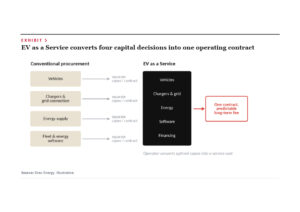
The model is EV as a Service. Instead of buying vehicles, chargers, energy, and software separately, an operator signs one long-term contract and pays a predictable fee. Upfront capital expenditure becomes a service cost, and technology and integration risk move to the party best equipped to carry them.
Sirec has already run the model at smaller scale. ZAP Taxi Club, its Attica e-taxi programme with Ethniki Leasing and FREENOW, bundles the vehicle with financing, insurance, maintenance, energy, and dedicated charging. It enrolled 100 electric taxis within 18 months of launch and is building a network of 60 fast chargers across 10 locations in Attica.7 Heavy fleets present the same problem at a larger ticket size. “We are not just financing vehicles, we are financing the transition to electrification,” said Dionisis Alissandratos, chairman and chief executive officer of Sirec Energy.7
The €4bn in the NECP is an estimate of what the transition will cost, not capital anyone has committed. Whether it is deployed will depend less on the next generation of batteries than on whether Greek fleet operators can buy electric transport as an operating cost rather than a capital one.
SOURCES
- IEA (2026), Global EV Outlook 2026, “Trends in other EV modes”. Licence: CC BY 4.0.
- ACEA, “New commercial vehicle registrations: vans +1.9%, trucks +9.8%, buses +22.7% in H1 2026”, 29 July 2026; ACEA full-year releases for 2025, 2024 and 2022.
- Hellenic Republic, revised National Energy and Climate Plan 2025–2030, investment breakdown as reported by energygame.gr and energypress.gr, August 2024.
- Fortune Business Insights, Heavy-Duty Electric Trucks Market, report FBI115984, updated 13 July 2026.
- Revised NECP charging-point estimate and installed base, as reported by energypress.gr (23 August 2024) and ienergeia.gr (9 November 2023).
- Revised NECP treatment of LNG and bio-LNG in heavy road transport, as reported by energypress.gr, 12 August 2024.
- Sirec Energy, “Heavy-duty electrification comes to Greece as a service – Sirec Energy and VEV join forces”, 10 September 2026; also reported by ypodomes.com and ot.gr.
- ACEA, Vehicles on European Roads, January 2026 (fleet data as of 2024).
- Athens and Thessaloniki bus procurement as reported by businessdaily.gr (29 December 2025), mononews.gr (21 February 2026), and voria.gr (9 April 2026).
This article is for information only and does not constitute an offer or solicitation. Figures are as published by the cited sources at the date of writing.